Following completion of this course, ≥ 92% of participants will know what Palliative care is and the benefits of palliative care.

CEUFast, Inc. is accredited as a provider of nursing continuing professional development by the American Nurses Credentialing Center's Commission on Accreditation. ANCC Provider number #P0274.
Following completion of this course, ≥ 92% of participants will know what Palliative care is and the benefits of palliative care.
By the end of this course, the participant will be able to:
Globally, approximately
| Type of Service | Examples of Service |
|---|---|
| Physical Care | Assistance with bathing, dressing, toileting, feeding, and transferring. |
| Practical Assistance | Home modifications, such as ramps, walk-in seated shower stalls, and elevated toilet seats. Assistance with transportation, medication administration, and home cleaning and maintenance. |
| Medications | Pain and symptom management. |
| Emotional Support | Counseling, respectful communication, provision of information, and connection with others. |
| Spiritual Support | Help in finding meaning, purpose, and a sense of belonging. |
Adapted from World Health Organization (WHO), 2022.
Globally, approximately 57 million people need palliative care, but only 8 million (14%) of these individuals receive palliative care services (WHO, 2020).
The most common conditions that adults experience, requiring palliative care, are (WHO,2020):
Although palliative care is characterized by an interdisciplinary or multidisciplinary approach, palliative care services are not standardized and vary widely. Despite this lack of standardization, a meta-analysis of randomized controlled trials (n = 21) found that quality of life, healthcare outcomes, and healthcare costs are improved when palliative services are provided (Naoum et al., 2024).
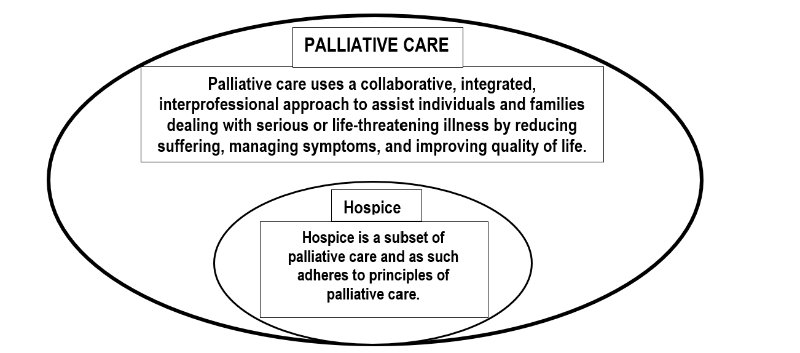
Palliative care includes hospice care.
Figure 1: Relationship Between Palliative and Hospice Care

Adapted from National Institute of Aging (NIA), 2021
Principles of palliative care are also applicable to hospice care. However, because hospice care is a specific type of palliative care, the two types of care can be differentiated by their scope and the timing/duration of service. Table 2 clarifies these differences.
| Palliative Care | Hospice Care |
|---|---|
| Includes end-of-life, chronic, and curative care. | Focused exclusively on end-of-life care. |
| Provide at any point or throughout a life-threatening or serious illness. |
Adapted from National Institute of Aging (NIA), 2021.
Approximately 50% of Americans covered by Medicare in need of end-of-life services receive hospice care. The median duration of hospice services is 17 days. Focus group research of individuals that included patients, caregivers, and health care professionals (n=63) found that reasons people who need hospice care do not access services include inadequate understanding of hospice goals and services, lack of knowledge about the benefits of hospice care, uncertainty about how to obtain hospice care, and concerns about payment for services (Tate et al., 2020).
Ensuring that individuals with six months or less to live, their families, and healthcare providers have accurate information about hospice services and benefits may enable eligible individuals to access this care. Primary care or specialists may refer individuals at the end of life for hospice care. When an individual has six months or less to live, Medicare, Medicaid, and many private insurers cover hospice services.
The majority of people with a serious or life-threatening illness express fear about experiencing unbearable pain at the end of their lives (Shi et al., 2025). Approximately 80% of individuals with cancer or AIDS and 67% of individuals with cardiovascular or respiratory disease experience moderate to severe pain in the latter stages of their illness. While providers often have concerns about using opioids,
A variety of pharmacological options that involve the use of opioids are available to effectively manage end-of-life pain. These pharmacological options mildly reduce alertness and do not increase the risk of delirium. Use of opioids at the end-of-life significantly decreases pain and anxiety, improves quality of life, and does not result in significant adverse effects (Fürst et al., 2020).
| Strategy | Specific Techniques |
|---|---|
| Collaboration | Soliciting other people’s perspectives Shared decision-making |
| Compassion | Feeling supported, valued, and heard by healthcare providers and family |
| Insight | Gaining knowledge about the typical trajectory of the condition Learning from others with similar experiences, as well as receiving guidance from providers |
| Unconventional Thinking | Creative problem-solving Viewing an issue from different perspectives |
Adapted from Ghosh & Blair, 2025.
Fear is defined as a negative anticipation of a possible future. Individuals with a serious or life-threatening illness may have many fears, such as fear of pain, frailty, dependency, loneliness (Rupprecht et al., 2022), decreased functional ability, unpredictable symptoms, being a burden to family (Ebrahimi et al., 2023), and illness progression (Chen et al., 2025; Ebrahimi et al., 2023).
To empathetically understand the perspective and fears of individuals experiencing a serious or life-threatening illness from the person's perspective, health care providers should be knowledgeable, competent, and present, being genuine and completely engaged during an interaction (Grant & Johnson-Koenke, 2024). Clinicians should help individuals adapt and develop healthy strategies to cope with the challenges associated with serious or life-threatening illnesses. Individualized education, collaborative family care (Ebrahimi et al., 2023), spiritual care, and cognitive therapy may be beneficial in addressing these fears (Chen et al., 2025).
|
Health care providers can assist isolated individuals in dealing with serious or life-threatening illnesses by (Hirakawa et al., 2022; Maloney et al., 2025):
Palliative care is focused on managing symptoms. Baseline and ongoing assessment should occur to identify and prioritize symptoms that interfere with quality of life. Based on assessment findings, individualized strategies to manage these symptoms should be designed and implemented (Pramod, 2025).
When a person is diagnosed with a serious or life-threatening illness, the individual and their family experience complex emotions and simultaneously need to make many difficult decisions, each of which may have a profound impact on everyone involved.
Safety is a palliative care priority. If an individual is unsafe, their entire palliative care plan could be jeopardized. For example, confusion, weakness, pain, and impaired mobility increase the risk of medication errors and falls. Strategies may include arranging for caregivers, bathroom safety bars, walkers or wheelchairs, and fall-notification devices.
Clinicians should assess resource needs and recommend resources that could improve quality of life. Types of resources may include family assistance, home healthcare providers, third-party financial providers (such as insurance, Medicare, Medicaid, and/or the Veterans Administration), and community outreach groups (such as churches, charitable organizations, or other service organizations).
The 1990 Patient Self-Determination Act mandated that health care agencies receiving Medicare and Medicaid notify patients about their right to be involved in medical decision-making and ask if they have advance directives. As a result of this Act, each state has laws related to advance directives. Types of advance directives include a health care power of attorney, a living will, a do-not-resuscitate order, and a physician's orders for life-sustaining treatment (House et al., 2025). Clinicians should be knowledgeable about the pertinent state laws and acceptable documents and provide accurate information and resources to individuals experiencing a serious or life-threatening illness.
Health care providers should examine all aspects of the individual’s unique situation, including their values, needs, and perspective. Questions that clinicians may ask when conducting a comprehensive assessment include:
Disparities can be categorized as economic, population-focused, and those without an advocate. Various strategies can be employed to mitigate disparities for individuals in need of palliative care; however, all persons with a serious or life-threatening illness should have access to accessible, affordable, and appropriate palliative care early in the course of their illness (Shi et al., 2025).
The individuals most likely to receive palliative care are
Children: All children with a serious or life-threatening illness should receive palliative care (WHO, 2020).
Ethnic and Religious Disparities: In the United States, African Americans are less likely to have access to palliative care than persons with other ethnic backgrounds. Because their religious beliefs may not be understood or respected,
Rural Disparities:
When individuals with a serious or life-threatening illness do not have a support system and have to navigate the health care system by themselves, they are at risk of not receiving palliative care and of receiving potentially inappropriate care, such as cardiopulmonary resuscitation, intubation, and being placed on a ventilator (Swidler, 2025). People who are ill and alone are vulnerable (Cho et al., 2024). Without a palliative care team, decisions are often made to protect hospitals, physicians, and other healthcare providers from legal liability, rather than prioritizing the best interests of the person (Swidler, 2025).
Educational, practice, and policy strategies to mitigate disparities for individuals in need of care include the following (WHO, 2020).
To ensure that all individuals with a serious or life-threatening illness receive palliative care, the following factors should be considered: availability, accessibility, accommodation, affordability, and acceptability. Table 4 provides information about each of these factors.
| Factor | Components |
|---|---|
| Availability | Nearby primary care and specialty providers who provide palliative care services Nearby hospitals, long-term care facilities, and community agencies that provide palliative care Physicians, nurses, social workers, and other health care providers are trained to provide palliative care services. |
| Accessibility | Available and affordable transportation to services Use of mobile health, telehealth, and remote services |
| Accommodation | Individualized, person- and family-centered care |
| Affordability | Coverage by insurance and payment mechanisms for low-income and uninsured individuals Informal support networks at low or no cost |
| Acceptability | Respecting individuals’ and families’ religious and philosophical perspectives |
Adapted from Shi et al., 2025.
| Summary of Study Findings: |
Ethical issues associated with palliative care include prioritizing family members’ wishes over patients’ wishes and end-of-life decisions for unrepresented individuals.
Clinicians often face an ethical dilemma when an individual is nearing the end of their life, and family members’ wishes for end-of-life treatment differ from the individual's own wishes, who may no longer be able to effectively express their wishes. The person may wish to have all treatments possible to extend life, and the family may wish to withhold treatments that will not result in health improvement and may cause suffering. Alternatively, the person may wish not to undergo treatments that will result in no health improvement and may actually increase suffering, while the family may wish to utilize all possible treatments to extend life. Even when the person has made their wishes known in legal form or when the person is no longer able to advocate for themselves and has granted a family member medical power of attorney, health care providers often make decisions based on their potential legal liability instead of what is in the individual’s best interest (Swidler, 2025).
When individuals with a serious or life-threatening illness are receiving palliative care, these decisions are often clear-cut. However, when the decision is unclear, the matter may be referred to an ethics committee. Unfortunately, treatment decisions often need to be made quickly, and the work of an ethics committee takes time. This situation reinforces the need to initiate palliative care when a person has been diagnosed with a serious or life-threatening illness so decision-making can be proactive (Swidler, 2025).
Disabled, homeless, incarcerated, mentally ill, older, socially isolated, and substance-dependent individuals are less likely to receive palliative care and be represented with regard to end-of-life decision-making than other individuals.
Essential features of palliative care are the provision of hope, respect, comfort, and honest communication.
The collaborative care model is characterized by a regular process in which individuals interact with their healthcare providers to jointly address expectations, problems, and goals. Outcomes of this model include the promotion of hope, reduction in symptom severity, and an increased quality of life (Ebrahimi et al., 2023). Hope need not be for physical recovery or survival.
Palliative care should be person-centered and include a comprehensive assessment of an individual’s biological, psychological, social, economic, and spiritual health (Ghosh & Blair, 2025; Pramod, 2025). Health care providers should be respectful of and responsive to individuals’ values, needs, and preferences, and recognize that the person’s perspective should guide clinical decision-making. Clinicians should take time to listen to and acknowledge people’s feelings and incorporate individuals’ wishes into their care (Pramod, 2025).
Continuity of care and consistency promote comfort (Pramod, 2025).
When a person is diagnosed with a serious or life-threatening illness, the individual needs to make complex and difficult health, physical, emotional, social, financial, and spiritual decisions that may have serious ramifications for the person and their family. Clear and accurate information, along with a repertoire of possible options, enables individuals to make decisions that are congruent with their values and perspectives. Healthcare providers need to offer enough information so that the person can make an informed decision, but not so much information that clarity about the issue is lost. Clinicians need to provide pertinent information and context for decision-making, clarify the decision that needs to be made, help the person identify and articulate their goals and values, respond to verbal and non-verbal cues, and acknowledge the intense emotions that the individual and their family are experiencing (Fraser et al. 2020).
Ms. Green is a 78-year-old woman who has lived alone in her family's house since her husband passed away 5 years ago. She is in good physical health overall, but about 2 years ago, Ms. Green was diagnosed by her primary care provider with early dementia. She has been taking donepezil (Aricept) 10mg daily. Ms. Green says the medication seems to have helped, but she has experienced increasing moments of “forgetfulness”, such as misplacing her keys and phone, and recently missing a dental appointment.
She presents to the memory clinic accompanied by her 49-year-old daughter, who lives and works about 500 miles away. She has no other children. Her daughter is concerned that Ms. Green is “falling through the cracks” and feels that her primary care provider has not been proactive in addressing her condition. Ms. Green’s mother and grandmother both suffered from severe dementia, so Ms. Green and her daughter are anxious about her future. They are at the memory clinic because several members of Ms. Green’s church are patients there and have mentioned the clinician’s thoroughness and expertise.
The baseline assessment includes a comprehensive history and physical examination, laboratory work, electrocardiogram, and various assessment tools, such as the Mini-Mental State Exam. The assessment confirms that Ms. Green has cognitive signs consistent with her stated history. She is still functioning well at home, despite her occasional memory lapses, but she also describes moments of brief confusion, where she feels a bit lost or disoriented. She is preparing her own meals and eating regularly. She appears adequately hydrated. Ms. Green reports that she does not have a will, a trust, a living will, a power of attorney, or a medical power of attorney.
It was decided that Ms. Green will stay on donepezil (Aricept) 10mg daily for memory. No other medications were added.
Personal resources, such as family, neighbors, and friends, were discussed. Ms. Green says she has been active in her church for many years and has received offers for assistance should she need help. She has Medicare and supplemental insurance. Her house is paid for, and she has some limited savings.
Her stated goals are to avoid being a burden to her friends and family, not to have to go into an institution, to die at home, and to “not lie around like a vegetable for years.”
Initial interventions include providing her with a living will to complete and return, as well as having copies for herself and her daughter. She was advised to see an attorney in the near future to help her prepare a will or trust, a power of attorney, and a medical power of attorney document. The clinician gently points out that Ms. Green’s ability to sort through what she wants and how she wants things done will likely deteriorate as her disease progresses, and the goal is to help her maintain a good quality of life.
The clinician addresses home safety, such as installing bathroom grab bars as needed, avoiding throw rugs, and obtaining a medical alert bracelet or watch. Ms. Green and her daughter were encouraged to discuss living contingencies since most people with dementia are unable to safely remain at home throughout the progression of the disease. They were also advised to consider and discuss the logistics and practicality of living so far apart.
Since Ms. Green is still able to function safely living alone, the clinician discusses possible strategies for assistance and, eventually, home care by friends, family, and professionals. She was encouraged to think about how she wants things to unfold as she becomes increasingly unable to live independently and begins considering options now.
Since the clinician recognizes that Ms. Green has transitioned from being “falling through the cracks” to likely being somewhat overwhelmed with information, tasks to consider, and realities to process, a follow-up appointment is scheduled in two weeks to further assist her in optimizing her quality of life.
CEUFast, Inc. is committed to furthering diversity, equity, and inclusion (DEI). While reflecting on this course content, CEUFast, Inc. would like you to consider your individual perspective and question your own biases. Remember, implicit bias is a form of bias that impacts our practice as healthcare professionals. Implicit bias occurs when we have automatic prejudices, judgments, and/or a general attitude towards a person or a group of people based on associated stereotypes we have formed over time. These automatic thoughts occur without our conscious knowledge and without our intentional desire to discriminate. The concern with implicit bias is that this can impact our actions and decisions with our workplace leadership, colleagues, and even our patients. While it is our universal goal to treat everyone equally, our implicit biases can influence our interactions, assessments, communication, prioritization, and decision-making concerning patients, which can ultimately adversely impact health outcomes. It is important to keep this in mind in order to intentionally work to self-identify our own risk areas where our implicit biases might influence our behaviors. Together, we can cease perpetuating stereotypes and remind each other to remain mindful to help avoid reacting according to biases that are contrary to our conscious beliefs and values.